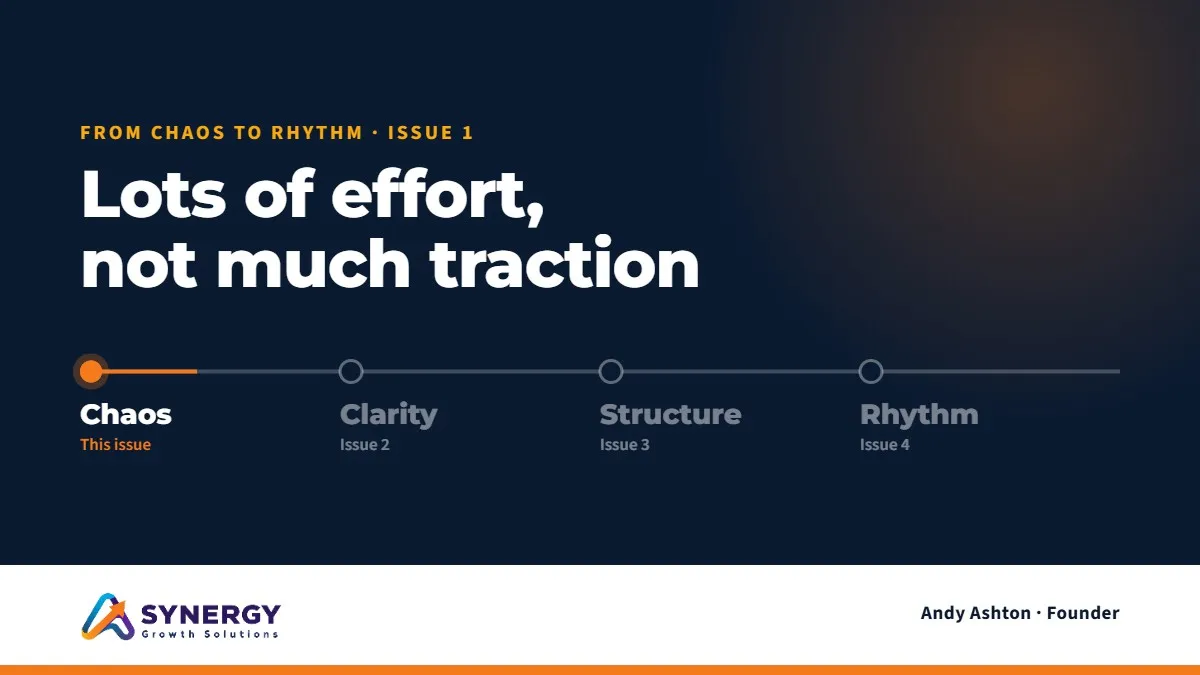
Lots of effort, not much traction: six signs your sales activity isn't connected
This is the first issue of From Chaos to Rhythm, my fortnightly newsletter for owners of engineering and technical businesses.
In most engineering and technical businesses I work with, the problem isn't a lack of effort. It's a lot of effort that never quite turns into predictable results. Every two weeks I'll look at one step from the chaos most businesses recognise to the rhythm that makes growth predictable.
This issue: where most businesses start.
What I see
It's never a lack of effort. The businesses I work with are full of capable people working hard to grow.
A telesales campaign. A push on LinkedIn, with regular posts for a while. A round of prospecting. A database of thousands of contacts, ready to be worked. Quotes going out every week. A new CRM.
Each one is a good idea, started for the right reasons. Some run for weeks, some for months. But most eventually fizzle out. Time gets tight, priorities shift, or the results don't come quickly enough.
The reason is usually the same. Each initiative runs on its own. It isn't planned as part of something bigger, it isn't structured to last, and it isn't aligned with everything else. The LinkedIn activity doesn't feed the prospecting. The prospecting doesn't feed the pipeline. Quotes go out with nobody owning what happens next. And because nothing was set up to be measured, nobody can say what actually worked.
Underneath it all, there's often a risk nobody is tracking. Many businesses in this space have built really strong relationships with their customers, but typically with just one or two contacts in each. What happens when they leave?
From the inside, it feels busy. The effort is real. It just isn't adding up to as much as it should.
Why it happens
Chaos rarely arrives overnight. It builds through small, sensible decisions made under pressure, each one solving today's problem, none of them connected to the last.
It isn't a people problem. It's a structure problem.
Six signs you might be there
You've started more commercial initiatives in the last two years than you could list from memory.
At least one of them was dropped before anyone could say whether it worked.
Your CRM and your spreadsheets tell different stories.
Each salesperson sells in their own way.
Your forecast is mostly a feeling.
Your biggest customers depend on one or two relationships.
If two or more of those sound familiar, you're not alone. It's the most common starting point I see.
What I learned as a GM
Even at Watson-Marlow, a well-run global business, effort could outrun the system. For many years we ran on a global ERP with basic CRM functionality, and changing it wasn't a local decision. The team was capable and working hard. What held us back wasn't effort. It was the structure around it.
The way out isn't doing more
Businesses don't become predictable by doing more. They become predictable by connecting what they already do.
That usually happens in three steps: clarity on what will make the biggest difference, structure to make it repeatable, and a rhythm that keeps it going. Over the next few issues I'll take each one in turn.
It's also why I prefer working with privately owned businesses. They have the autonomy to make those changes, and to make them quickly.
Over to you
How many of the six signs did you recognise? And when it comes to sales, what's the biggest frustration or opportunity you see at the moment?
If you'd like an objective view of where your business sits, get in touch.
Andy