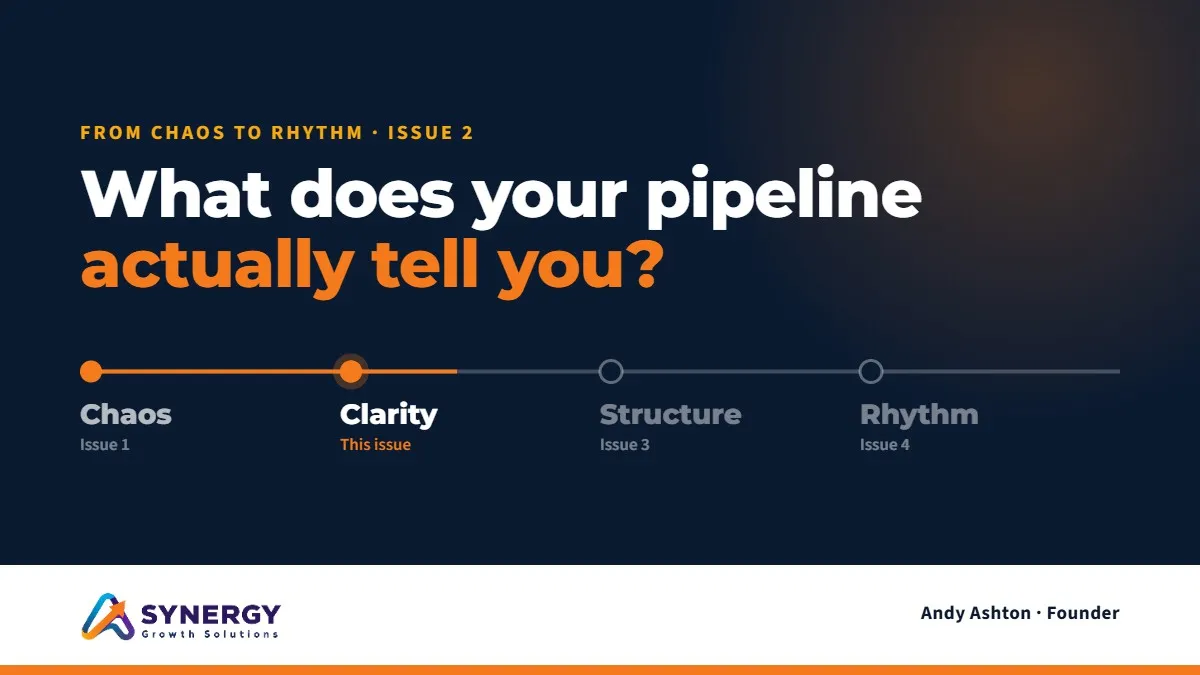
What does your pipeline actually tell you? Six questions for technical B2B businesses
Welcome back. In issue 1 I looked at chaos: lots of effort, not much traction, and nothing connected. This issue is about the first step out of it. Clarity.
Clarity doesn't mean knowing everything. It means knowing enough, from your own numbers, to say what will make the biggest difference next, and what won't.
What I see
Ask most owners how sales is going and the answer is "fine". Ask what's in the pipeline and you'll usually get a number. Ask what that number is made of and it goes quiet.
In most CRMs, a speculative enquiry from two years ago sits alongside a deal that's ready to order. Stages mean different things to different people. Values are guesses, or blank. Dead quotes never get closed down, so the total keeps growing while the orders don't.
Why it happens
Nobody sets out to build a messy pipeline. It builds up. There are no agreed rules for what goes in, what each stage means or when something comes out. Nobody owns the review. And because it's hard to get anything useful out of the system, people stop trusting it and keep the real picture in their heads.
What I learned as a GM
When I took over the UK business at Watson-Marlow, we had an old, slow CRM. What went into it was unreliable: stages, values, all of it. There were no real rules, no playbook, no oversight and no rhythm. Often the sales team didn't see an enquiry until it had already been quoted, and the more complex quotes could take a week to go out. As the market leader we already carried a premium price, so a slow quote was a real risk.
The CRM also held the rest of the world's quotes, so it was a mess, and nobody was following those quotes up or closing them down.
In 2012 we built a dedicated team to support the UK operation: application engineers, a coordinator, a marketer, customer service advisers and a support team manager. The same year we started preparing for a move to a global ERP and CRM. It finally went live on 5 May 2015, the day after the bank holiday. Not a date I'll forget in a hurry. For the UK team it was a step backwards. One pipeline held everything, from every speculative lead to fully qualified opportunities ready to order.
So I wrote our sales process. It was built around best practice, but constrained massively by a system that was never designed for direct sales. Even so, it gave us the clarity we needed to keep the wheels turning and keep deals moving through the business.
Alongside it, we built a spreadsheet we could export the raw data into. It was rough to start with. But once we could break the pipeline down by sales engineer, sector and product, we suddenly had meaningful data. It supported real decisions: where to put effort, what to coach, and what activity was needed. The sector view I shared on LinkedIn recently came straight out of it.
A quick self-check
Could you say today how much of your pipeline is likely to close in the next 90 days?
Does every stage mean the same thing to everyone who uses it?
When did someone last close down the quotes that died?
Can you see the pipeline broken down the way you make decisions, or only as one total?
Does every opportunity have an owner and a next action? "Waiting to hear back" is not a next action.
How long does a quote take to go out?
If two or more of those are hard to answer, you have a clarity problem, not an effort problem.
The way forward
You don't need a new system to get clarity. Start with agreed definitions for each stage, an owner and a real next action on every opportunity, a clear-out of dead quotes, and one view of the pipeline broken down the way you make decisions. Then look at it on a set rhythm, with someone who owns it.
That's where structure starts, and it's what issue 3 is about.
Over to you: when it comes to sales, what's the biggest frustration or opportunity you see at the moment? If you'd like an objective view of where your business sits, get in touch.