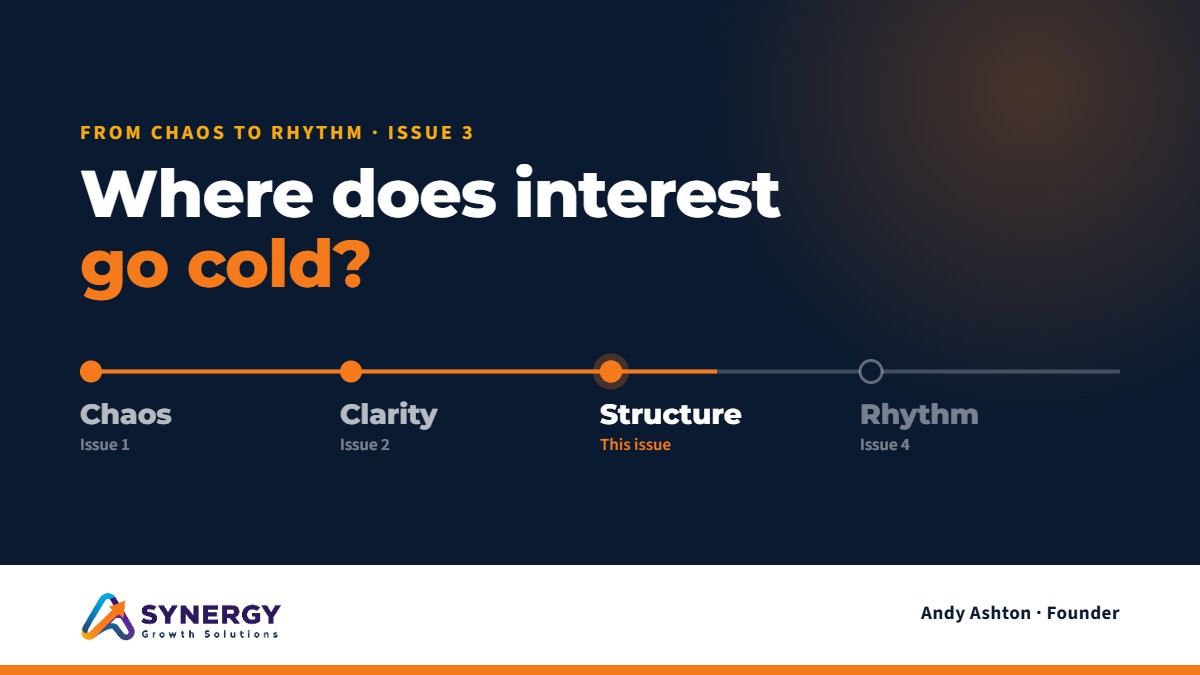
Where does sales interest go cold? Six questions for technical B2B businesses
Welcome back. Issue 1 was about chaos: plenty of effort, nothing connected. Issue 2 was about clarity: knowing what your pipeline actually tells you. This issue is the next step. Structure.
Earlier this week I wrote about the handovers an enquiry passes through before a customer speaks to the right person. This issue picks up from there: what happens after that first conversation.
Structure has a bad name. It sounds like forms, approvals and more admin. In a sales operation it means something much simpler: deciding in advance what happens next, and who does it, so nobody has to remember.
What I see
Most interest in a technical business doesn't die. It goes cold, quietly, somewhere between the first conversation and the order.
A quote goes out and goes quiet. Nobody agreed what would happen next, so the follow-up becomes a chase, and then it stops.
An enquiry isn't ready yet. It gets a brochure and a "let us know", and nothing after that.
A show lead sits in a pile until it feels too late to call.
A customer mentions a second site or a new line, and nobody asks again.
At PPMA in September I asked a few exhibitors how they'd follow up after the show. Most said they'd work through it. A few had a proper process.
None of these is a lost order on the day. Added up over a year, they're worth a lot more than they look.
Why it happens
Not because people don't care. Because the work that keeps interest warm has no owner and no trigger. Today's orders, quotes and breakdowns always shout louder. Follow-up depends on someone remembering, and in a busy week nobody does.
And because the rules were never written down, everyone works to their own. One engineer follows up every quote twice. Another never does. The business gets the average.
The system should drive the process, not whoever happens to remember.
A quick self-check
Does every live quote have a next step agreed with the customer, with a date?
Does every enquiry that isn't ready yet have a dated reason to come back?
Does every lead have one named owner?
Is follow-up prompted by the system, or by someone's memory?
When a quote is lost, is the reason recorded?
Of last quarter's enquiries, how many are still alive, and how many did you simply stop talking to?
If more than two of those are a "no" or "not sure", interest is going cold somewhere in your business, and you probably won't see it until the order book thins.
With clients now, one of the first things I put in place isn't more leads. It's what happens to the ones they already have. Every lead gets a named owner and a follow-up task the day it arrives. Every quote goes out with a next step and a date. Anything that isn't ready yet gets something useful every few weeks, sent without anyone having to remember. The CRM raises the tasks and the team works through them.
The way forward
Start with the places interest goes cold, and decide what happens at each one:
Every quote goes out with a next step agreed: when they expect to decide, and when you'll next speak.
Every "not yet" gets a date and a reason to come back: something useful to send, or a question about their project.
Every lead and every enquiry has one named owner.
There's a simple rule for when something is closed, and the reason is recorded when it is.
That's structure. It only works if someone looks at it regularly, which is where rhythm comes in. That's issue 4, out on 2 December.
Over to you: when it comes to sales, what's the biggest frustration or opportunity you see at the moment?
If you'd like an objective view of where your business sits, get in touch.